Weekly instalment loans are a type of financial facility where one repays dues weekly rather than monthly. It thus helps clear the loan quickly. It is a short-term instalment loan for small needs and emergencies. The amount and the repayment term stay small. It is the reason the interest rates and total loan costs stay high on these loans.
Despite the cost, weekly instalment loans are quite a favourite among low and middle-income households. It provides an extra cash push when one needs it the most. One can turn any cash emergency into a stress-free outlook. Moreover, these loans are easier to access compared to other instalment loans.
What are weekly instalment loans?
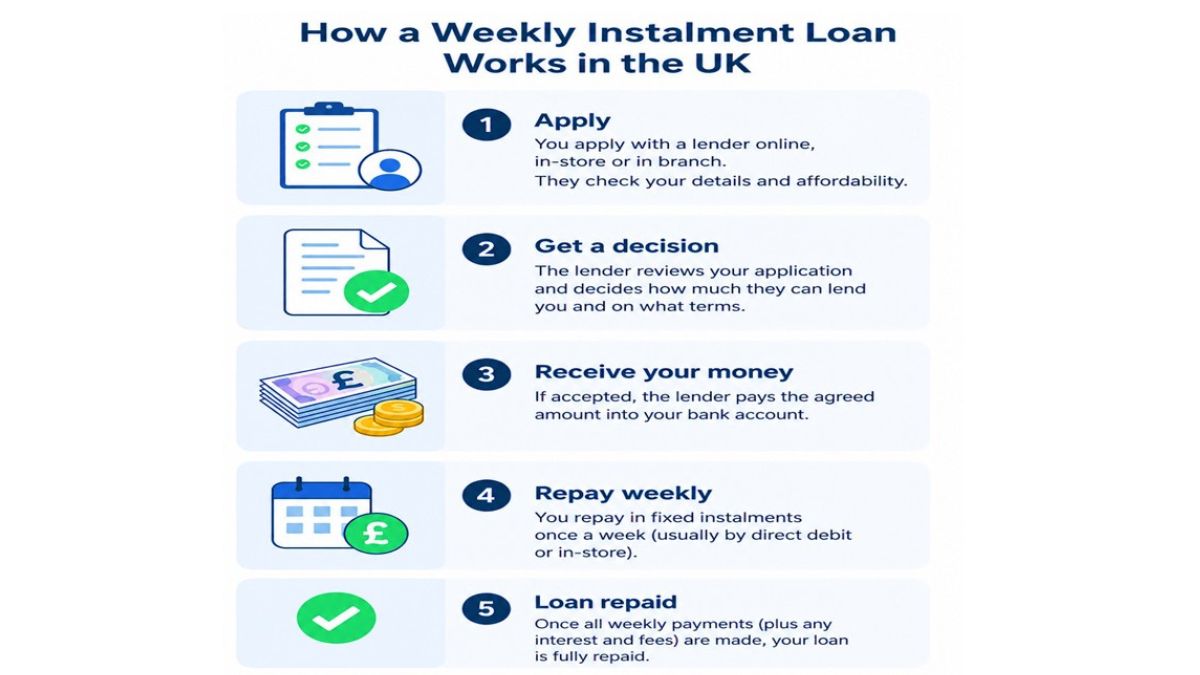
Weekly installment loans are a type of personal loan where you get a lump sum and repay it in fixed weekly instalments. These are short-term funding options and ideal for managing financial emergencies or meeting a funding gap.
Why are weekly instalment loans getting popular?
Weekly instalment loans are getting popular among UK households because they are flexible and more affordable than payday loans. By spreading loan payments over weeks rather than months, one may get debt-free quickly. It does not tie one to a long-term debt payment structure.
One can use it to address emergencies without engaging in detailed documentation. Moreover, the complete loan application and cash transfer happen online. One does not need to provide documents manually. It reduces the turnaround times, and one gets the cash the same day. Here are other reasons for its popularity:
Helps counter rising living costs
According to Media.Jobins.com, “Monthly costs excluding rent typically range from £824-£1,124 for a single person”. However, average salaries being £2,599 (before tax) make it nearly impossible for one to cover these expenses swiftly. It is the reason most households depend on weekly instalment loans. It helps them cover high living expenses like rent, energy, food, transport and other expenses before paydays.
With stagnating real incomes and high living costs, spreading payments over several weeks rather than paying monthly in a lump is more comfortable.
Faster access to cash
Online loan companies and BNPL providers approve the weekly instalment loans quickly. It does not require much detailed assessment and documentation. Individuals with a decent income and well-managed finances may get a quick loan from a direct lender online.
It saves time that one can use to meet a critical need. Moreover, low documentation reduces the turnaround times. It helps you get cash within an hour of approval. It just requires one to provide accurate details. There should be no discrepancy in the actual vs. the application form details.
Moreover, most loan companies use Open banking technology. In this, one tallies the information online. It eliminates the need for manual documentation.
This speed appeals to younger or low-income borrowers who may lack strong credit histories or patience for the traditional underwriting process. Thus, it is a modern approach to getting loans for urgent needs.
Irregular income schedules
Individuals with irregular salaries are the worst sufferers of irregular housing costs. They struggle to clear the payments on time. It eventually attracts high interest, late payment penalties and overall interest costs. It affects the credit score drastically. Thus, individuals who receive weekly incomes can benefit from weekly instalment loans.
It is because they don’t have to adjust their budget much. Instead, they can use the loan to pay a bill and later repay the dues the next week in a small instalment. It reduces the risk of missing a payment or defaulting on a loan. Moreover, the ability to budget easily makes weekly repayment schedules more attractive for the borrowers. It does not tie them in like the monthly schedules.
Perception of “safe credit”
It is interesting to know that most borrowers don’t see weekly instalment loans or Buy Now Pay Later as a real threat. They don’t consider it as “debt”. Instead, they view it as an arrangement to split the purchase cost into weekly instalments for a long term or across paydays.
This perception reduces the psychological barriers related to borrowing. It is even though that its repeated use may create affordability and over-indebtedness.
Thus, individuals with regular income may get instant approval. It becomes easier for individuals with a decent income to counter repayments without a major budget setback.
Regulatory and Marketing dynamics
Regulatory changes have made standard credit cards and some overdrafts more expensive or harder to access. It pushes some borrowers towards alternative credit products. At the same time, the FinTechs and BNPL providers have aggressively marketed weekly or short-term instalment options. It contributes to their rapid uptake across the UK population.
What are some risks of weekly instalment loans to know about?
Weekly instalments loans can be especially risky for low-income borrowers because they often charge high interest and fees. The repayment rhythm can trap individuals with inconsistent incomes into a debt cycle.
They may eventually struggle to get debt-free. The structure may seem “manageable” week by week, but the cost and commitment can quickly overwhelm individuals on a strict budget.
High costs and hidden charges
Many weekly payment loans carry triple-digit annual percentage rates (APRs) or large service fees, so the total amount repaid exceeds the original loan. Low-income borrowers usually have less room to absorb the extra costs. It eats into money that would otherwise prove helpful in meeting the essential costs.
Risk of repeated or flipped loans
If the borrower fails to keep up, the loan companies may roll the loan into a new one. It resets fees and drags the debt into a longer term. It turns a short-term fix into a long-term debt. It may prove a high obligation that reinforces financial vulnerability rather than solving it.
Over-indebtedness
When weekly payments crowd a limited income, borrowers often defy or miss basic bills like rent, utility bills and groceries. This may create a debt spiral. This is where new loans are tabled to cover the pending debts or the basic living costs. It may make it more challenging for the borrower to repay the dues on time.
Damages the credit and long-term commitment
Late or missed weekly payments may hurt the credit score. It makes it harder to access cheaper and mainstream credit. It could be a mortgage or cheaper personal loans. For low-income households, it may prove to be the biggest obstacle. It is because this may halt the long-term wealth-building plan.
Bottom line
Weekly instalments loans are ideal for individuals facing minor cash issues before payday. It reduces the hassle of paying monthly instalments. Instead, one can split it into affordable weekly instalments. Identify how much you can afford for the loan repayments. Accordingly, you can choose the loan repayment term.
Roscoe Tanner

Roscoe Tanner is the Editor-in-Chief, leading a large team of writers at Versityloans . He has expertise in writing for various borrowing options like personal loans, long-term and short-term loans, unemployed loans and many more. Roscoe joined Versityloans in 2015 but previously worked with many reputed loan companies. He performs the major role as the editor, covering key aspects of loans and finance. Roscoe Tanner wants to serve at large in the progress of the company and to present a modern alternative to the traditional financial industry in the UK. He is a Certified Financial Planner and has a god-gift of connecting with people through his valuable suggestions and writings. His expertise as a writer and editor in the finance industry is based on his education qualification. Roscoe has done a Master of Business Administration (MBA) in Finance.